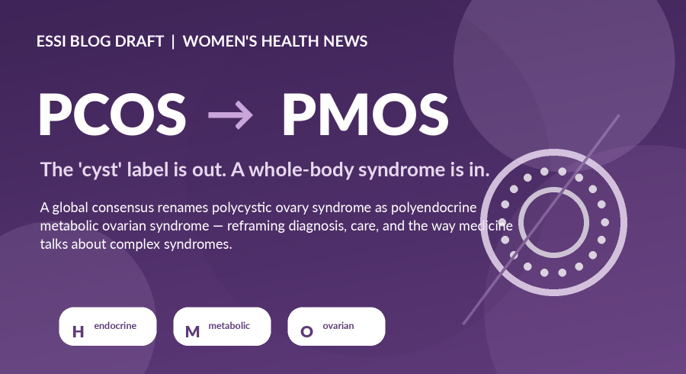
“PCOS” is no longer PCOS.
After a 14-year global effort involving clinicians, researchers, and patient advocates, the condition historically known as Polycystic Ovary Syndrome has officially been renamed PMOS: Polyendocrine Metabolic Ovarian Syndrome.
This change matters more than most people realize.
For years, the name “PCOS” centered ovaries and “cysts,” even though many women diagnosed with the condition do not actually have ovarian cysts at all. The old terminology reduced a deeply complex hormonal and metabolic condition to a reproductive issue, leaving many patients misunderstood, dismissed, or diagnosed far too late.
The new name reflects what healthcare providers and women living with the condition have been saying for decades: this is not just an ovarian condition. PMOS affects the endocrine and metabolic systems throughout the body and can influence insulin regulation, energy levels, skin and hair health, ovulation, fertility, mood, inflammation, cardiovascular risk, and long-term hormonal balance.
At Soul Tree, we see the impact of this every day. Women come to us exhausted from being told to “just lose weight,” frustrated that their symptoms were minimized because their labs appeared “normal,” or confused because they were told they could not have PCOS without cysts.
The shift from PCOS to PMOS is more than a name change. It is a long-overdue recognition that women’s hormonal health deserves a more accurate, comprehensive, whole-body approach.
Hormones do not function in isolation. Metabolism affects ovulation. Stress affects insulin. Sleep affects cortisol. Inflammation influences everything. When healthcare focuses only on isolated symptoms instead of root causes and interconnected systems, women are often left trying to piece together their health on their own.
We are hopeful this change moves the conversation forward toward earlier diagnosis, more comprehensive care, less stigma, and better long-term outcomes for women everywhere.
Most importantly, we hope it helps more women feel seen.
If you have struggled with irregular cycles, acne, fatigue, hair changes,
fertility challenges, weight fluctuations, or symptoms that never seemed fully explained, you deserve care that looks at the full hormonal picture.
The name changed. Now the standard of care needs to change too.