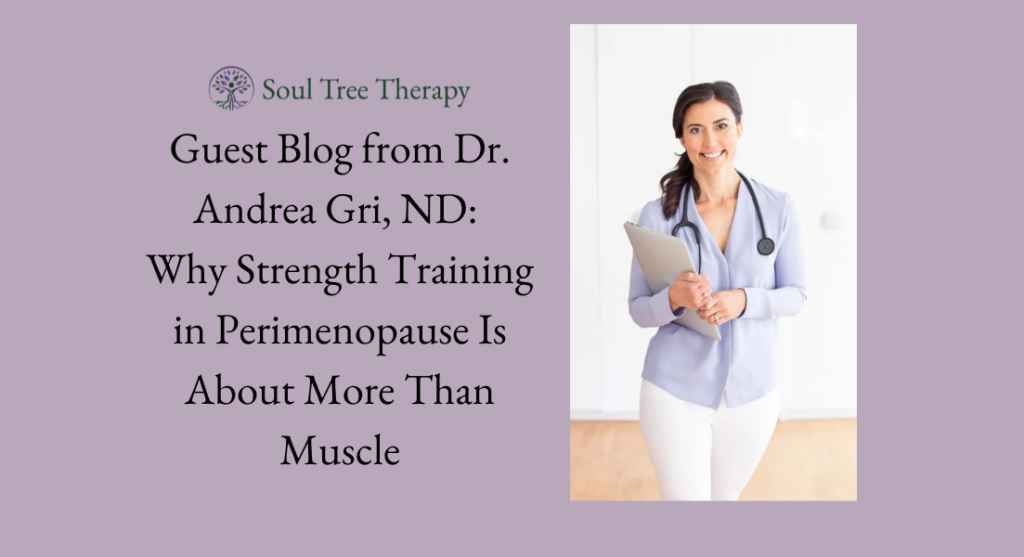
We’re thrilled to share this insightful article, written exclusively for Soul Tree Therapy by Dr. Andrea Gri (ND), exploring why strength training during perimenopause is about so much more than building muscle.
Why Strength Training in Perimenopause Is About More Than Muscle
Perimenopause is a time of significant change. During this transition, hormone levels, particularly estrogen, begin to fluctuate. These changes can contribute to symptoms such as hot flashes, mood changes, sleep problems, weight shifts, and joint discomfort. For many women, the experience can feel unsettling, and they report not feeling like themselves anymore.
The good news is that strength training, also known as resistance training or weightlifting, is one of the most powerful tools available to help you navigate this stage of life. While many people associate strength training with building muscle, its benefits extend far beyond physical appearance. In fact, one of the most overlooked benefits of strength training during perimenopause may be its ability to support emotional resilience and rebuild trust in your body.
What Is Resilience?
Resilience is often defined as the ability to adapt to and recover from challenges. In practical terms, it is the feeling that you are capable of handling a stressor.
During perimenopause, many women notice a shift in their capacity to manage stress. Challenges that once felt manageable may feel more overwhelming, particularly when layered on top of chronic stress, poor sleep, nutrient deficiencies, adverse childhood experiences, trauma, or the demands of a busy life.
As a result, many women report feeling less resilient than they used to. Situations they would have handled with ease in the past may suddenly feel much harder.
The Physical Benefits Are Important
There is no question that strength training provides important physical benefits during perimenopause.
Research shows that progressive resistance training can help preserve muscle mass, improve strength and balance, support bone health, improve insulin sensitivity, and contribute to healthy aging. Exercise can also improve sleep quality, which is particularly valuable during a life stage where sleep disruption is common.
These benefits matter. But they are only part of the story.
Building More Than Muscle
When most people think about exercise, they think about burning calories or building muscle.
What is often overlooked is that strength training can also change how you see yourself.
Progressive strength training involves gradually increasing the challenge placed on your body over time. This might mean lifting a heavier weight, performing more repetitions, improving your balance, or completing an exercise that once felt impossible.
Every time you achieve one of these milestones, you provide your brain with evidence that you are capable.
This concept is closely linked to self-efficacy, which is the belief in your ability to successfully manage challenges and achieve goals. Higher self-efficacy has been associated with better symptom management, improved wellbeing, and greater quality of life during the menopause transition.
In other words, strength training does more than build stronger muscles. It helps build confidence in your ability to navigate difficult situations.
Each workout becomes a reminder: “I can do hard things.”
Why Showing Up Isn’t Always Enough
One of the reasons strength training may be particularly powerful for emotional resilience is that it involves progression.
Simply attending a class or going through the motions may not create the same effect.
The real psychological benefits come from challenge, mastery, and growth.
When you gradually become stronger, your brain learns that effort leads to improvement. You begin to trust yourself and your body again. This is especially important during perimenopause, when many women feel as though their body is becoming unpredictable or working against them.
Strength training offers a different narrative.
Rather than focusing on what your body can no longer do, it highlights what your body is still capable of learning, adapting to, and achieving.
Rebuilding Trust in Your Body
One of the most common things I hear from women in perimenopause is: “I just don’t feel like myself anymore.”
This feeling can be difficult to describe. It is not always about weight gain, hot flashes, or sleep disruption. Sometimes it is the sense that your body is no longer familiar.
Strength training can help rebuild that relationship.
As your body becomes stronger and more capable, you gather evidence that it is still adaptable and resilient. Many women notice that the confidence they build in the gym begins to extend into other areas of life, including work, relationships, and managing stress.
This is where the connection between physical strength and emotional resilience becomes especially powerful.
A Different Way to Think About Exercise
Many women approach exercise with the goal of shrinking their body.
Perimenopause may be an opportunity to shift that mindset.
Instead of focusing on restriction, consider focusing on what you are trying to build:
Strength
Muscle
Confidence
Resilience
Balance
Long-term health
This shift can be incredibly freeing.
Rather than punishing your body for changing, you begin investing in its future.
The Bottom Line
Strength training in perimenopause is about much more than muscle.
Yes, it supports healthy aging, stronger bones, better balance, and improved physical function. But it also offers something many women are looking for during this stage of life: a renewed sense of confidence, capability, and trust in their body.
When done consistently and progressively, strength training becomes more than exercise. It becomes evidence that your body is still strong, still adaptable, and still capable of meeting life’s challenges.
And sometimes, that’s exactly the reminder we need.
References
Yue H, Yang Y, Xie F, et al. Effects of physical activity on depressive and anxiety symptoms of women in the menopausal transition and menopause: A comprehensive systematic review and meta-analysis of randomized controlled trials. International Journal of Behavioral Nutrition and Physical Activity. 2025.
Cunha PM, Werneck AO, Nunes JP, et al. Resistance training reduces depressive and anxiety symptoms in older women: A pilot study. Aging & Mental Health. 2022.
Dąbrowska-Galas M, Dąbrowska J. Physical activity level and self-esteem in middle-aged women. International Journal of Environmental Research and Public Health. 2021.
Magistro D, Vagnetti R, Ansdell P, Piasecki J. Self-efficacy, quality of life, physical activity and educational interventions in menopausal women: A cross-sectional and pre-post study using Bayesian structural equation modelling. Maturitas. 2025.
SantaBarbara NJ, Whitworth JW, Ciccolo JT. A systematic review of the effects of resistance training on body image. Journal of Strength and Conditioning Research. 2017.
Sá KMM, da Silva GR, Martins UK, et al. Resistance training for postmenopausal women: Systematic review and meta-analysis. Menopause. 2023.
Lam CM, Hernandez-Galan L, Mbuagbaw L, et al. Behavioral interventions for improving sleep outcomes in menopausal women: A systematic review and meta-analysis. Menopause. 2022.
About the Author
Dr. Andrea Gri, ND, MSCP is a naturopathic doctor practicing in Burlington, Ontario, with a focus on women’s hormonal and metabolic health. She helps women navigate perimenopause, menopause, PCOS, weight and body composition changes, and the frustrating symptoms that can arise when they no longer feel like themselves.
As a Certified Menopause Society Practitioner (MSCP) and creator of The Metabolic Method™, Dr. Andrea takes an evidence-informed approach that combines nutrition, movement, sleep, hormone health, and body composition analysis to help women improve metabolic health, rebuild strength, and feel more confident in their bodies.
Known for her compassionate and practical approach, Dr. Andrea believes that health is about more than the absence of disease. It is about having the strength, energy, resilience, and confidence to fully participate in life at every stage.